🔥Early Bird•5 seats left
AI-Empowered Leading SAFe® Agilist Certification Training
100% assured results12 September 2026Bonus: Course resources included2 Days / 16 Hours
🔥 Early Bird Price
35,49941,999
SAFe®
In-depth 52-question guide for SAFe practitioners covering core Scaled Agile principles, PI execution, team syncs, built-in quality, Lean-Agile mindset, and value stream delivery.

The Scaled Agile Framework (SAFe®) helps enterprise organizations deliver business value predictably by coordinating multiple Agile teams within Agile Release Trains (ARTs). SAFe practitioners must understand both team-level execution and enterprise cadence.
This guide contains 52 comprehensive questions covering foundational SAFe principles, PI Planning, iteration execution, cross-team collaboration, and scenario-based problem solving.
Beginner Questions (26)
SAFe® (Scaled Agile Framework) is a framework for applying Lean, Agile, and DevOps principles across large organizations. It helps multiple Agile teams collaborate and align their work with business strategy and customer value.
Organizations use SAFe to coordinate multiple Agile teams, improve business and technology alignment, manage dependencies, increase delivery speed, improve quality, and deliver value more predictably.
SAFe is built around principles such as:
An Agile Release Train is a long-lived team of Agile teams that works together to deliver a continuous flow of value. An ART typically consists of 5–12 Agile teams working toward a common mission.
A Program Increment is a fixed timebox during which an ART delivers incremental value. A PI commonly lasts 8–12 weeks, with many organizations using approximately 10–12 weeks.
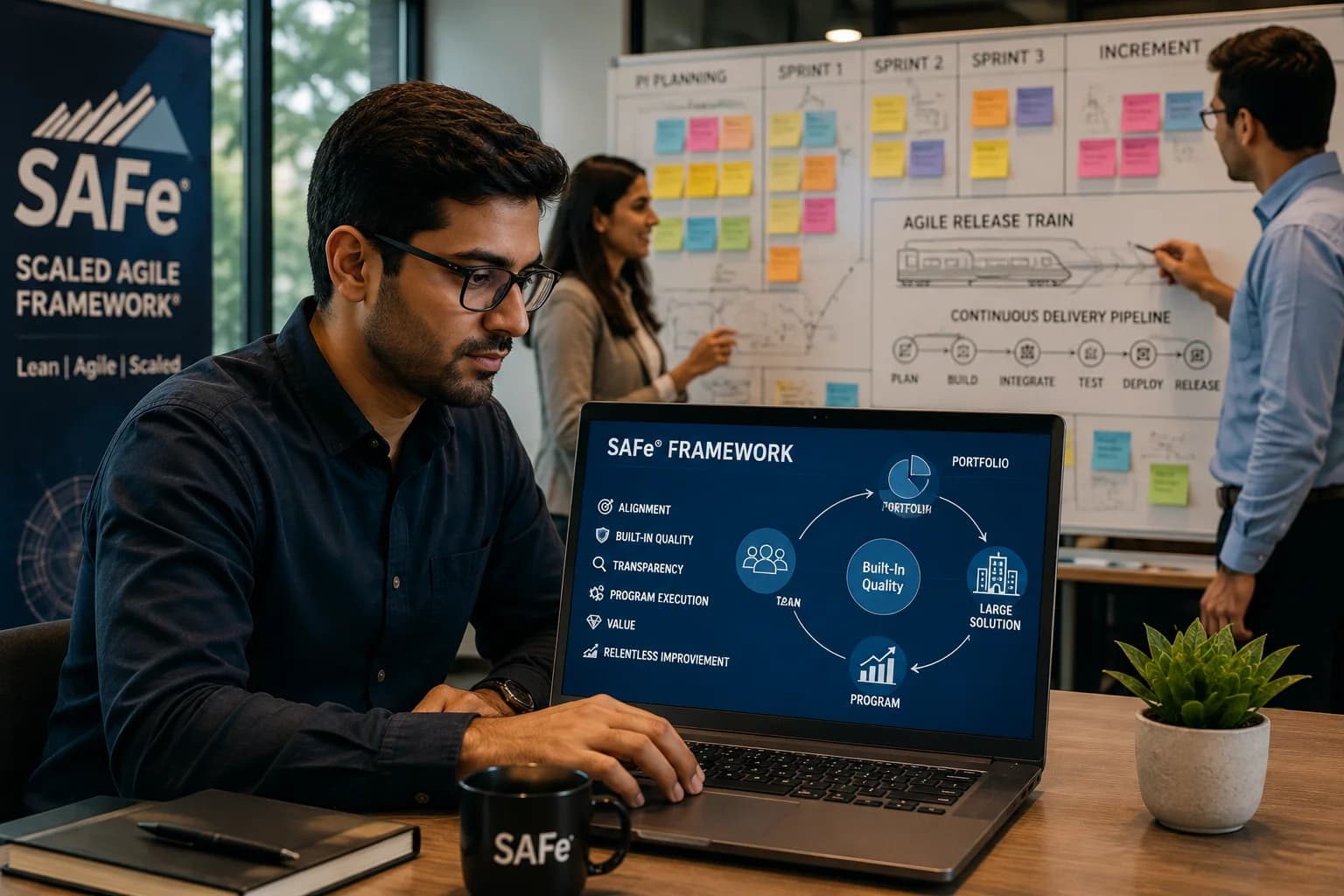
SAFe interviews evaluate your understanding of the Lean-Agile Mindset, SAFe Core Values, and how Agile teams collaborate during PI Planning and iteration execution to deliver value continuously.
Review key concepts: Agile Release Trains (ARTs), PI Objectives, Program Board dependency mapping, ROAMing risks, Built-in Quality, Innovation and Planning (IP) Iterations, System Demos, and Inspect & Adapt workshops.
 Project Management Professional (PMP®) Certification TrainingDisciplined Agile® Leadership (DAL®) Certification TrainingDisciplined Agile® Foundations (DAF®) Certification TrainingProgram Management Professional (PgMP)® Certification TrainingPortfolio Management Professional (PfMP)® Certification TrainingPMI Agile Certified Practitioner (PMI-ACP)® Certification Training