From managing Agile ceremonies to driving business outcomes: discover how the modern SAFe Scrum Master combines leadership, business agility and Artificial Intelligence to build high-performing teams.
Introduction: The Changing Role of the Scrum Master
In today's competitive business environment, organisations are under constant pressure to deliver products faster, improve customer experiences, adapt to market changes and achieve better business outcomes.
Agile ways of working have become an important part of this transformation. However, adopting Agile practices alone does not guarantee success. The real difference comes from how effectively teams collaborate, manage priorities, overcome challenges and continuously improve.
This is where the Scrum Master plays a vital role.
A Scrum Master is much more than someone who schedules meetings, manages sprint activities or follows up on tasks. A capable Scrum Master is a facilitator, coach, problem solver and change enabler who helps teams work towards shared business objectives.
With the introduction of Artificial Intelligence into the Agile workplace, this responsibility is evolving further.
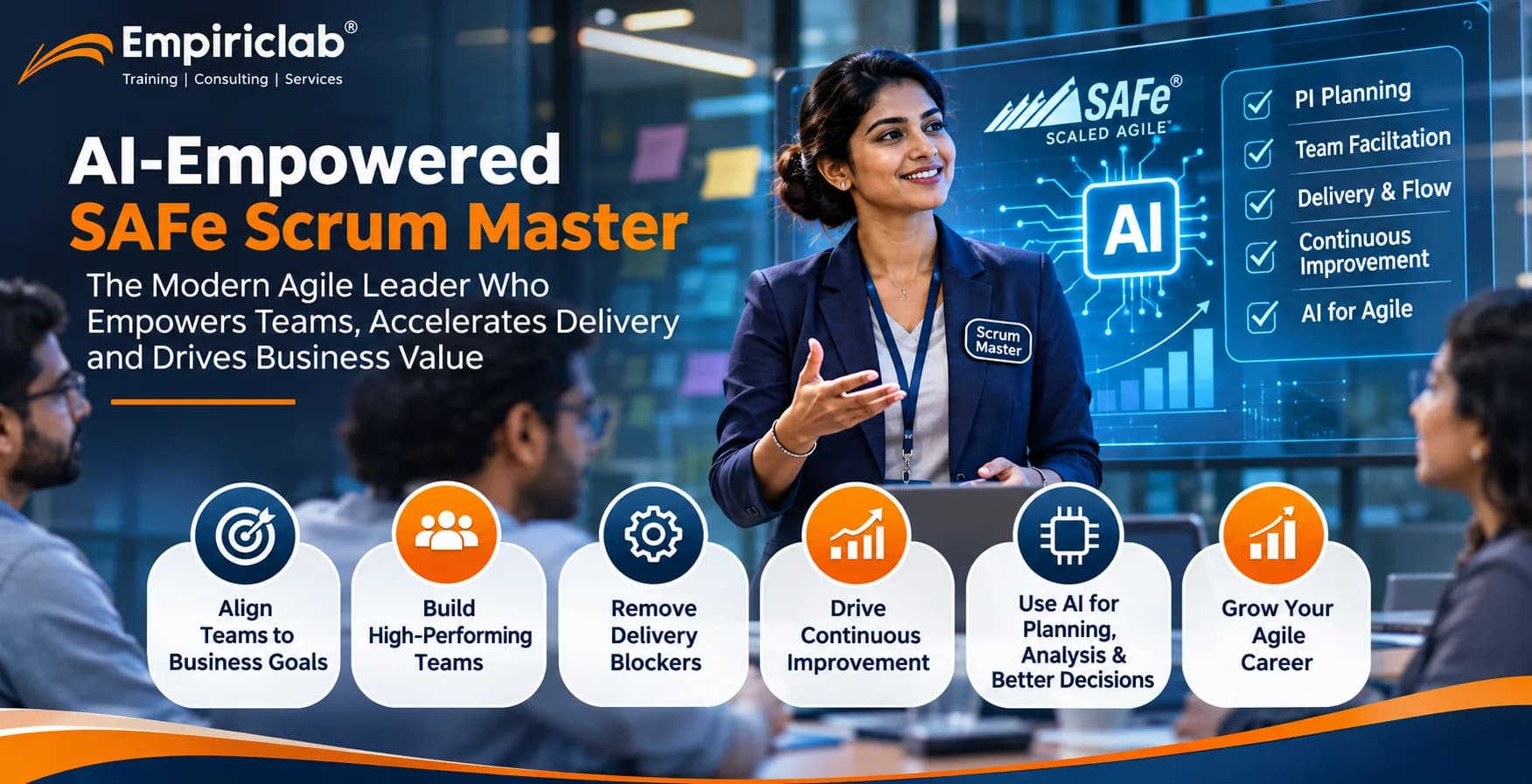
The AI-Empowered SAFe Scrum Master brings together the principles of the Scaled Agile Framework (SAFe), effective team leadership and practical AI capabilities to help professionals become more effective in modern enterprise environments.
1. Why Is the Scrum Master So Important to Any Business?
Every business depends on people, processes and technology working together. Even organisations with excellent strategies can struggle when teams lack alignment, communication or clarity.
The Scrum Master helps address these challenges.
1.1 Connecting Teams with Business Goals
A team may complete every sprint successfully, but is it delivering the outcomes that matter to the business?
The Scrum Master helps teams understand priorities, align their work with product objectives and maintain focus on delivering meaningful value.
In a SAFe environment, this responsibility extends beyond an individual Agile team to the wider Agile Release Train (ART).
1.2 Removing Obstacles That Slow Down Delivery
One of the most important responsibilities of a Scrum Master is identifying and addressing impediments.
These may include:
Dependencies between teams.
Delayed decisions and approvals.
Communication gaps between business and technical teams.
Unclear priorities and changing requirements.
Process inefficiencies and resource constraints.
By helping teams resolve these challenges, Scrum Masters improve the flow of work and create an environment where people can focus on delivering value.
1.3 Building High-Performing Teams
High-performing teams are not created simply by assigning tasks and setting deadlines.
They require trust, accountability, collaboration and continuous learning.
The Scrum Master encourages self-management, facilitates meaningful discussions, supports conflict resolution and helps team members take ownership of their commitments.
1.4 Enabling Continuous Improvement
Successful businesses continuously inspect their performance and adapt their approach.
Through retrospectives, feedback, Agile metrics and Inspect & Adapt practices, Scrum Masters help teams identify what is working, what is not and what needs to change.
This creates a culture of improvement rather than a culture of simply completing tasks.
2. How SAFe Takes the Scrum Master Role to the Enterprise Level
While Scrum provides a framework for team-level collaboration, large organisations often need to coordinate multiple teams working towards common business objectives.
This is where the Scaled Agile Framework (SAFe) becomes important.
A SAFe Scrum Master works within a larger delivery ecosystem, supporting teams while collaborating with Product Owners, Release Train Engineers and stakeholders.
Some of the key responsibilities include:
PI Planning: Helping teams prepare for and participate in Program Increment Planning.
Iteration Execution: Facilitating effective planning, daily coordination, reviews and retrospectives.
Dependency Management: Helping teams identify and manage cross-team dependencies.
ART Collaboration: Supporting alignment and coordination across the Agile Release Train.
Team Coaching: Encouraging Lean-Agile practices, accountability and continuous improvement.
Inspect & Adapt: Helping teams evaluate outcomes and identify improvement opportunities.
The objective is not simply to make teams Agile. It is to help the organisation become more responsive, collaborative and focused on value delivery.
3. Why Artificial Intelligence Is Changing the Scrum Master Role
Artificial Intelligence is transforming how organisations manage information, analyse performance and make decisions.
For Scrum Masters, AI offers an opportunity to reduce repetitive work and spend more time on activities that require human judgement, leadership and collaboration.
Consider some practical applications.
AI for Sprint Planning and Backlog Refinement
AI tools can help analyse backlog items, improve user story descriptions, identify missing information and suggest acceptance criteria.
This can help Product Owners and Scrum Masters prepare more effectively for planning discussions.
AI for Daily Stand-ups and Meeting Summaries
AI-assisted tools can help organise meeting notes, summarise discussions, highlight action items and identify unresolved issues.
This allows Scrum Masters to spend less time on administrative follow-up and more time supporting the team.
AI for Retrospectives and Continuous Improvement
AI can help organise retrospective feedback, identify recurring themes and suggest questions for further investigation.
However, the Scrum Master must validate these insights and ensure that improvement decisions reflect the actual experiences of the team.
AI for Agile Metrics and Delivery Insights
AI-assisted analysis can help examine delivery trends, identify potential bottlenecks and highlight patterns in team performance.
These insights can support better conversations about predictability, workflow and improvement opportunities.
AI for Coaching and Stakeholder Communication
AI can help Scrum Masters prepare coaching questions, structure difficult conversations, draft stakeholder updates and communicate complex information more clearly.
The important point is that AI does not replace the Scrum Master. It enhances the Scrum Master's ability to perform the role effectively.
Human judgement, empathy, ethical decision-making and leadership remain essential. AI-generated information must always be reviewed, and confidential business or team information must be handled responsibly.
4. What Makes an AI-Empowered SAFe Scrum Master Different?
The modern Scrum Master needs more than knowledge of Scrum ceremonies.
They need the ability to combine three important capabilities:
Agile and SAFe knowledge: Understanding how Agile teams operate within a larger enterprise, how PI Planning works and how teams coordinate delivery.
Leadership and facilitation: Coaching teams, managing impediments, encouraging collaboration and supporting continuous improvement.
AI capability: Understanding AI fundamentals, prompting techniques, practical applications and responsible AI usage to improve day-to-day Scrum Master activities.
This combination helps professionals move beyond administrative responsibilities and contribute more meaningfully to business transformation.
5. How AI-Empowered SAFe Scrum Master Training Supports Your Career Growth
The demand for professionals who understand Agile delivery, enterprise collaboration and emerging AI capabilities creates an opportunity for Scrum Masters to expand their professional skills.
Whether you are an experienced Scrum Master or looking to develop your career in Agile delivery, this learning journey can help you build capabilities relevant to modern organisations.
Here is how the training can support your professional development:
Build Strong SAFe Knowledge
Understand how Scrum Masters operate in a SAFe enterprise and contribute to the coordination of multiple Agile teams.
Improve Leadership and Coaching Skills
Develop practical approaches to servant leadership, team facilitation, conflict resolution and continuous improvement.
Understand Enterprise-Level Delivery
Learn how PI Planning, ART execution, iteration planning and dependency management contribute to organisational objectives.
Develop Practical AI Skills
Understand how AI can support planning, retrospectives, backlog refinement, meeting summaries, coaching and delivery analysis.
Strengthen Your Professional Credibility
Prepare for the AI-Empowered SAFe Scrum Master (SSM) certification and demonstrate your understanding of modern Agile practices and AI-assisted delivery.
These capabilities can support progression towards roles such as:
SAFe Scrum Master
Senior Scrum Master
Agile Team Coach
Agile Coach
Release Train Engineer (with the additional experience and capabilities required)
Agile Delivery Lead
Certification alone does not guarantee a promotion or a new role. Its value comes from combining recognised learning with practical experience and the ability to demonstrate results.
Conclusion: The Future Belongs to Scrum Masters Who Continue to Evolve
The role of a Scrum Master is becoming increasingly important as businesses look for better ways to manage complexity, improve delivery and respond to change.
The next generation of Scrum Masters will need to combine people leadership, Agile expertise, enterprise thinking and the ability to work effectively with AI.
AI can make information easier to analyse and repetitive activities more efficient. But the ability to build trust, resolve conflicts, coach people and create a culture of continuous improvement remains fundamentally human.
If you want to strengthen your Agile career and understand how AI can enhance your role, the AI-Empowered SAFe Scrum Master certification is a meaningful step towards developing those capabilities.
Inspect. Adapt. Lead. Empower teams. Deliver business value.
Start your learning journey with Empiriclab.
Explore the AI-Empowered SAFe Scrum Master Certification Training:
https://empiriclab.in/safe/ai-empowered-safe-scrum-master-certification-training